
Industry Calls for an Open Wine Market in Canada
Originally published by WineAlign on February 11, available to its subscribers. This version is unchanged.
You may recall last spring that Canadian wine became a political focus of the promised breaking down of interprovincial trade barriers in response to Trump’s tariffs and building Canada’s self-reliance. The main idea was to introduce direct to consumer shipping (DTC) across provincial boundaries. A target for agreement (at least on a framework for agreement) was set for May 2026 – three months away. After that, the topic turtled.
But its head has popped out again in recent days as the Canadian industry seized the moment during a first ministers meeting January 29/30. Wine Growers Canada, the Canadian industry’s lobby arm in Ottawa, issued an open letter to the Premiers, asking them to create “an open national wine sales market including a harmonized direct-to-consumer wine delivery, by May 2026”.
But the letter then went farther. “Once a national DTC framework is implemented, provinces should shift their focus to opening the domestic wine market more fully, ensuring Canadian wine can compete fairly with imports, increase domestic market share, and drive regional economic growth, including investments in advanced agriculture, tourism, hospitality and adjacent sectors’
The whole issue came up again February 4 during a 90-minute webinar hosted by the Vancouver-based Canadian chapter of AIDV, an international wine law association. It was held to update on the interprovincial situation, and call for action.
The four panelists of the AIDV conference described and analysed the issues with which the provinces are dealing. It is complicated because each province has over 100 years of evolved regulatory, legislative and economic structures, and they need to deal individually with other provinces. Great fun for the lawyers, but rather frustrating and sleepy stuff for those who just want to be able to drink good wine from other provinces.
My interest perked right up however when conversation turned towards the federal government needing to do more to move things along. It was suggested that ‘the feds’ might have some legislative upper hand “to start imposing some order on this chaos” if provinces aren’t compliant.
And then came the thunderbolt from panelist David Clement, North American Affairs Manager of the Consumer Choice Centre, an international group that advocates against government regulation of several consumer products, including alcohol.
“This may seem radical” he began. “But if I could start over and redo the system I would abolish the provincial liquor boards, and create a national open market with a uniform national alcohol tax rate. It would resolve all the provincial revenue issues, and consumers across Canada would understand what they are paying for.”
Another panelist, lawyer Shea Coulson of Coulson Litigation & Advisory, made perhaps the most compelling argument that “a truly competitive market, without the arbitrary controls imposed by the liquor boards, would greatly improve productivity”.
The rest of the time was taken up with other reasons about why this was such a good idea. Of which I have never needed convincing. And given that the feds created the provincial liquor boards almost 100 years ago, it follows they should have some sort of constitutional levers within in the webbed clockworks of the Peace Tower to dismantle them.
Panelist Dan Paszkowski, CEO of Wine Growers Canada, who signed the open letter to the premiers mentioned above, was already on record in favour of this idea. His letter ended with the following statement.
“The public interest is clear: greater choice for consumers, fairer prices, stronger domestic supply chains, and a more resilient Canadian economy. Proven policy models already exist. Consumer demand is evident. The opportunity now is to act”


Spearhead of East Kelowna Offers New Vintage of “Dual Citizen” Series
The complicated nature of the current Canada-US relationships does not seem likely to be ironed out soon. So, it strikes me as particularly interesting, ironic, and poignant that B.C. wineries like Spearhead are announcing the next vintage of their wines made from grapes purchased in the USA. I am all for this on so many levels.
For background, a deep freeze in the interior of B.C. in January 2024 all but wiped out the 2024 vintage, with vineyards without near presence moderating lake-effect suffering the worst damage and needing re-planting. Many wineries looked south of the border to Washington and Oregon to purchase ‘replacement’ grapes, which made all kinds of sense in terms proximity and perhaps some Pacific Northwest stylistic similarity in the wines.
The first reason to get behind these wines is that some B.C. wineries really needed to take this path to survive, and be solvent when their own vineyards revive. Especially when they are high achieving wineries like tiny Spearhead which took the National Wine Awards Winery of the Year title in 2024.
The second reason is that the American states selling their grapes to Canada are ‘blue’ Democrat states that oppose Donald Trump. Of the top ten wine producing states in the USA, nine are ‘blue’, which to me says something about the connection between wine and civility.
The third reason is that these ‘replacement’ wines can be very good. Last year the the top judges in the country tasted dozens of these wines, with reviews available at WineAlign. The Dual Citizen wines are very good, particularly a pair of single clone pinot noirs (Pommard and 777) that winemaker Grant Stanley has sourced from the Cherry Hill Vineyard in Oregon. One of Canada’s best noir winemakers gets to continue his journey. The Syrah from the Columbia Valley of Washington is very appealing, balanced and correct.
Henry of Pelham Launches ‘Developed Through Time’
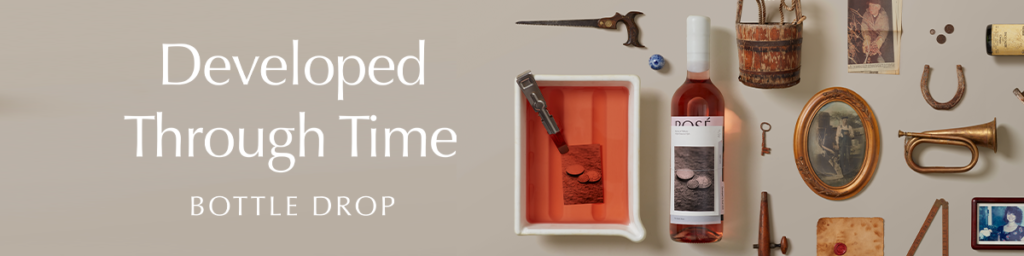
This seems a complicated concept at first, but very cool once you grasp the layers. I don’t often pay attention to marketing programs, but there is something here that goes a little deeper, joining history and technological advancement in a unique way. I will spend a moment to try to unravel it, but you are best served by going right to the website. https://henryofpelham.com/home/developed-through-time/.
Henry of Pelham is very history conscious, with the property in Pelham’s Corner at the edge of St. Catharines being in family hands for over 200 years. They have collected dozens of artiifacts that inform that history. But rather just house them in a museum they have come with a way to photograph the artifacts and apply them individually to labels on bottles of current wines. The very cool part is that the prints are developed using a wine-based product called Wineol that replaces traditional developing chemicals. And Wineol can be created from white, red or pink wines that lend their hue to final prints. Moreover, it is all done in a ‘dark room’ created in the wine cellar, and guests are invited to become part of the process.
There are 50 bottles in the series. They can be purchased at $50 each. Shipping is free and 100% of proceeds will be matched by Henry of Pelham and donated to Pathstone Mental Health in Niagara.

Two New (to me) Ontario Wineries Surface
Within the space of 24 hours two new wineries came to light, one via social media, the other via traditional media. I have not yet tasted wines from either, which I will attempt to do in the near future, and include if they are among Canada’s best.
Skye Chase Estate Winery opened January 25. It is a producer of grape-based wines and fruit wines located near St. Thomas (London area) in Elgin County. It does not lie within the existing Lake Erie North Shore appellation so will be Ontario VQA. It is actually a total re-make of Quai du Vin, but the website does not mention this history. It does feature a new 5,000 sq ft tasting, retail and restaurant space. The portfolio of at least 18 wines encompasses most styles, from both hybrid and vinifera grapes, and four fruit wines in bottles and cans. It also introduces a new team led by owner Kyle MacDonald, GM Russ Press and Head Winemaker Jay Johnston, who I remember well from his days at Niagara wineries like Hidden Bench, Flat Rock Cellars and Le Clos Jordanne. https://skyechasewinery.com/
Al Borgo Winery has actually existed as a property and brand for six years, but has announced something of a coming out in the local Niagara This Week publication, with the news that it will be creating “a three-storey complex with a 2,320-square-metre entertainment venue, a 250-person multi-use piazza, a ground-floor restaurant where diners can view the winemaking process, a community artisan marketplace, a café and education area”. Owner Alessandro Spassiani, first purchased 35 acres in 2019, located on Zimmerman Road in the Vinemount Ridge sub-appellation. His 8.9 ha vineyard includes Pinot Grigio, Pinot Noir, Chardonnay, Vidal, Baco Noir and Cabernet Franc. But interestingly, he has also planted new disease-resistant and cold-resistant hybrids that can withstand such as Sauvignon Rytos, Soreli, Cabernet Volos and Merlot Kanthus. It currently produces 3,000 cases but is aiming for 40,000 and making his winery an important tourist facility, complete with ten villas that are set to begin opening in April. https://alborgoestates.com/
Cheers, David