
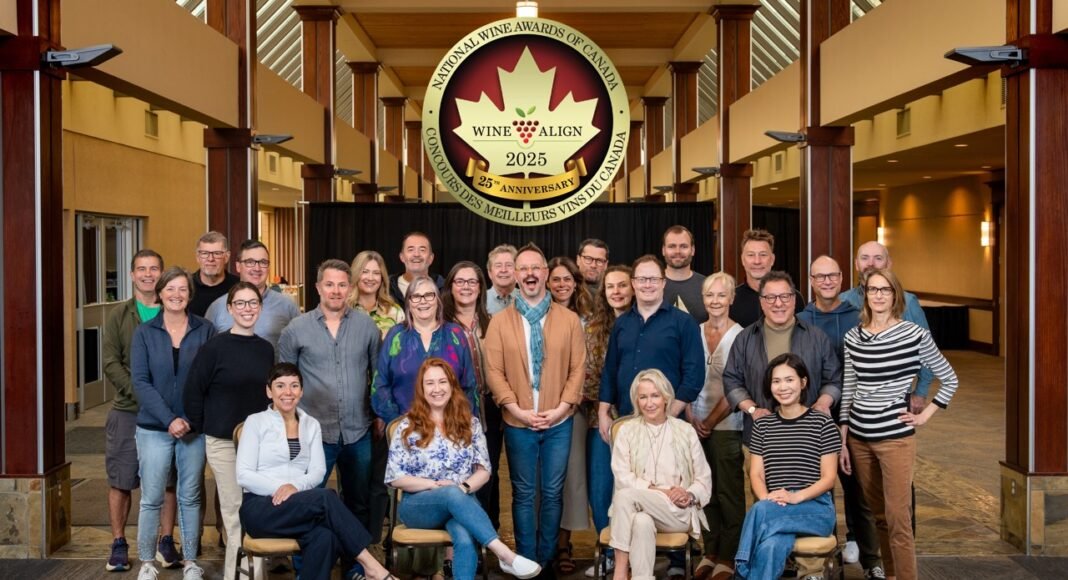
WineAlign National Wine Awards of Canada Opens Entries
The gates have swung open for the 25th running of the National Wine Awards of Canada June 12 to 17 in Niagara Falls. Submissions are flowing at a rate that suggests entries will be on par with the last two years, which despite short years in B.C, in 2023 and 2024, were healthier than expected. Some of this is being driven by the number of new wineries and cideries that continue to sprout across the country. I am tasked with combing the websites of winery associations and identifying those that are “new to me” and it has become a long job.
The “Nationals” were founded in 2001 under the auspices of Wine Access magazine, by Anthony Gismondi of Vancouver and yours truly. They were taken over by WineAlign in 2010, with same core of judges, volunteer and procedures in place.
The idea from the start was to assemble, intermingle and blind taste wines from coast to coast on a level playing field to gauge quality, and not to play one region against the other, which Canadians so readily do. Over the years the Awards not only recognized which wineries were consistently performing well, publishing lists of the Top 20 each year, but gradually the Awards affirmed which varieties and styles were not only doing well nationally, but within the provinces and their sub-appellations.
All medal wineries are listed at Winealign.com, and down the road many silver, gold and platinum winners will show up with more detailed reviews at Canada’s Best Wines as well.
New this year, the NWACs have created categories for “No-Lo” wines, with no or low alcohol. Obviously, it is a growth category that many are embracing if not out of out-right abstinence, but as way to drink less alcohol while still enjoying the social aspects of wine drinking. Which hopefully means that when they do drink real wine they are going upscale.
Entries “must be made either wholly or partially from grapes and can include hybrids such as products made from grapes blended with other fruits. There will be no restrictions on how they are made (unfermented verjus, various methods of removing or lowering alcohol, partial ferments, etc.).” But ingredients must be wholly Canadian. There are two basic categories: Non-alcoholic wines with < 0.5% ABV and low alcohol wines with < 7.5% ABV.
The WineAlign judges will also be tasting “replacement’ wines from the 2024 and 2025 vintages in British Columbia. These are wines made from Washington, Oregon and California fruit imported to help offset the devasting loss of production caused by the January 2024 deep freeze. The replacement wines will receive gold, silver and bronze awards but are not officially part of the standings of the National Wine Awards.
The Nationals run over five days each June, back and forth between east and west. We assemble a terrific crew of judges from east and west as well – roughly 20 give and take based on the number of entries. They are paid for their travel, accommodation and a generous honorarium. Each judge tastes about 90 wines each day, timed and ordered to be fair to the judges’ palates therefore the wines. They start at 8:30 and finish by 3:00. There is ample time for them discuss, learn and consider their initial impressions. Few judges turn down this invitation.
A seasoned team of volunteers, some who travel across the country on their vacations, ensure that the wines are served in proper sequence, on time and at ideal tasting temperature. Once on the judge’s table my role kicks in to oversee the quality control of the judging process. Largely it is doing re-pours of any wines with an inkling of flaw. But Anthony and I will sometimes become arbiters as the passionate and knowledgeable panelists discuss specific wines.
With wines from across Canada having to be in one place at the same time, there are shipping consolidation deadlines. Most importantly this year, B.C. wineries must be at the consolidation point by May 20. Ontario and Nova Scotia wineries must be assembled by June 5. Wineries click here for all the details.
The 2026 Canadian Wine Industry Awards
Wine Growers Canada (WGC) and Wine Growers British Columbia (WGBC) presented the 2026 Canadian Wine Industry Awards and BC Industry Recognition Awards, at a ceremony in Penticton March 31.
The Awards, sponsored by national accounting, tax and business firm MNP, are presented annually by WGC to “recognize individuals, organizations and businesses that have gone above and beyond to support and enhance the wine industry in Canada, celebrating the success, leadership, and outstanding commitment in Canada’s grape wine industry”
The winner of the Canadian Wine Industry Award of Distinction is The Stewart Family from Quails’ Gate Winery in West Kelowna. The Stewarts were among the first to plant vinifera in the Okanagan, and for three generations have been dedicated to premium quality wines, most recently opening Ailm Estate to produce sparkling wine in East Kelowna.
The Wine Industry Champion Award presented to an individual who has supported through media, policy or advocacy went to Miles Prodan who recently retired after 14 years as a director of Wines of British Columbia. Dan Paszowski, Director of WGC, noted that Mr. Prodan “was tenacious in his advocacy supporting interprovincial direct-to-consumer wine shipping,”
The Karl Kaiser Canadian Winemaker Award created in honour of a Canadian wine industry pioneer and viticultural visionary, went to Andrzej Lipiński of Big Head Wines in Niagara. Lipinski has been a visionary in his own right in employing the appassimento process in Ontario winemaking among several Niagara wineries.
The 2026 British Columbia Industry Recognition Awards were held at the same time
The Leadership Excellence Award honours an “individual, business, or organization whose work has meaningfully advanced the BC wine industry and BC VQA wine through media or research”. The award this year went Rhys Pender a friend, writer, educator and wine judge who has done so much over decades to raise awareness of BC wine quality.
The Ultimate BC Wine Ambassador Award celebrates a frontline winery professional who brings passion, knowledge, and authenticity to guest interaction. This year’s recipient is Brynne Dickson of CedarCreek Estate Winery.
The Master Marketer Award recognizes an innovative individual or organization that has demonstrated creativity and impact in promoting the Wines of British Columbia. The 2026 recipient is Jenna White, creator of the ThatBCWineGirl channel.
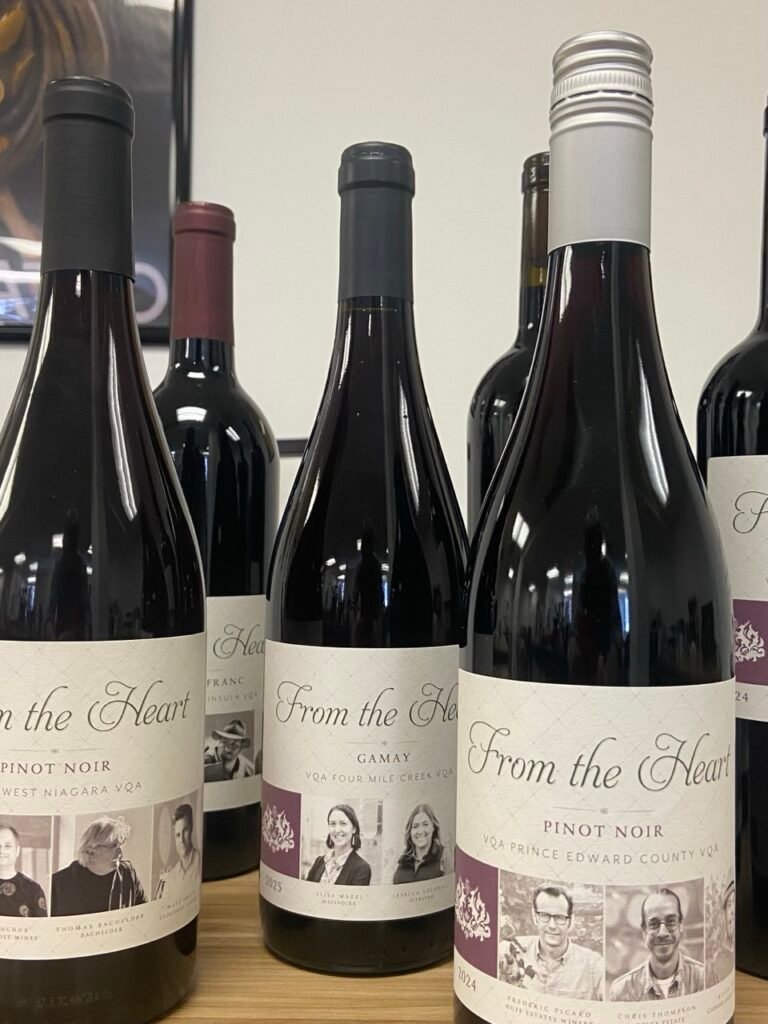
Cuvee From the Heart Raises $43,000 for Grapes for Humanity
From April 16 to 22 the annual on-line Grapes for Humanity Wine Auction raised over $600,000 for three worthy environmental organizations: Tree Canada, Nature Conservancy of Canada and Ontario Conservation Accelerator. The Cuvee from the Heart lots of specially-created Ontario wines contributed $43,000. The auction was hosted by Waddington’s Auction House.
There were hundreds of lots of some of the world’s finest wines, but of special interest to Canadian wine fans, were the mixed cases of 12 exemplary one-off Ontario wines bottled under the From the Heart label. The teams of three winemakers assembled to make each wine are a statement of who’s who and their specialties. And the overall level of winemaking prowess delivered typicity, detail and finesse. I was able to taste the wines just before the auction and I was very impressed.
The idea of involving teams of winemakers was the brainchild of Thomas Bachelder and Grapes for Humanity board member Steven Campbell. This was the third year of the program, but the first to go with a full twelve bottle mixed case, which for the first time included wines student teams from Niagara College (a skin fermented white) and Brock University (a sparkling riesling). There were 48 mixed cases up for auction, and seven individual cases of each wine.
At the auction launch event, held at Waddingtons Toronto office, Steven Campell announced that “it was the largest representation of Canadian wine ever seen at a fine wine auction in Canada”.
A full list of the wines and their winemakers is available at https://www.grapesforhumanity.com/. And my reviews for each of the wines are at www.winealign.com, along with notes from John Szabo and Michael Godel. Subscribers to WineAlign can access them immediately by searching From the Heart.
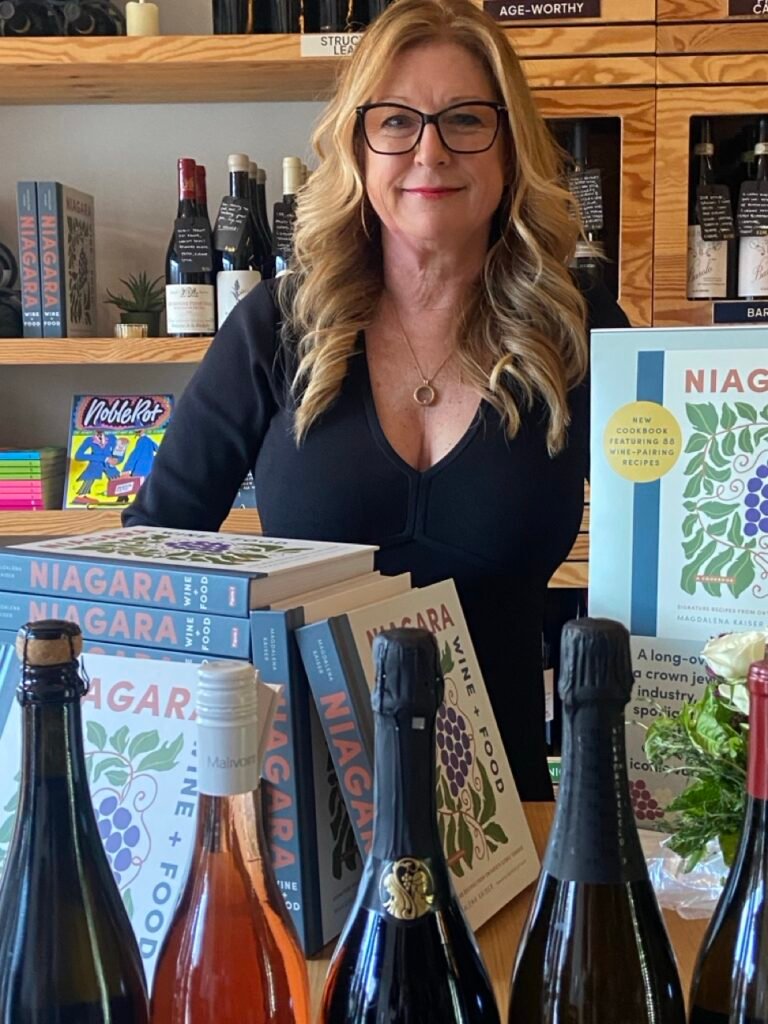
Magdalena Kaiser Launches Impressive Niagara Wine and Food Book
The daughter of original pioneer Ontario winemaker Karl Kaiser has gone deep to not only honour her father, but to cement her own affection for Ontario wine, and her own propensity for the culinary arts. She has authored an impressive hardcover, 287-page book titled “Niagara Wine & Food”, published by Figure One, which was founded in 2013 as a publisher of books on Canadian arts, culture and culinary.
Her wine knowledge is a given thanks to her upbringing – where she first tasted Inniskillin wines made in her father’s garage in the early 70s. Much later in life and for many years she was marketing director for Wines of Ontario. What I did not know is that she also had such a deep appreciation for food as well, for which she credits her grandmother Oka “the fairy of Austrian cooking and baking who taught me the art of creating delicious meals”. For years Magdalena has been a member of the Souffle Supper Club which gave her the confidence to undertake this culinary project.
Inspired by this group, Magdalena hatched the idea, approached and sold it to Figure One, then went to 44 Niagara wineries and asked them to put forward two wine and food pairings each. She diligently held full-on recipe and pairing trials and tweaking with all of them, which took over a year.
The book itself is more than recipes, pairings and stories, which of course is its bread and butter. I really like that she has gone to the extra effort to provide a timeline of Ontario wine’s history, to break down Niagara’s appellations and its grape varieties. Her vine roots are showing!
At a book launch held in the very cool Loop Line Bottle Shop on Dupont Street in Toronto, guests were treated to an eight-course sampling of dishes and pairings drawn from the book. It was a packed and boisterous room, assembling a who’s who of the Ontario wine and food media establishment.
Wines poured at the event were Charles Baker Cuvee de Boulanger (sparkling riesling), Malivoire Ladybug Rose, Two Sisters Blanc de Franc, York Vineyards Brut Nature, Leaning Post Senchuk Chardonnay, Cloudsley Pinot Noir, Stratus Red and Trius Red.
The book is officially being released May 26 but pre-sale copies are available at PRE-SALE ON NOW!
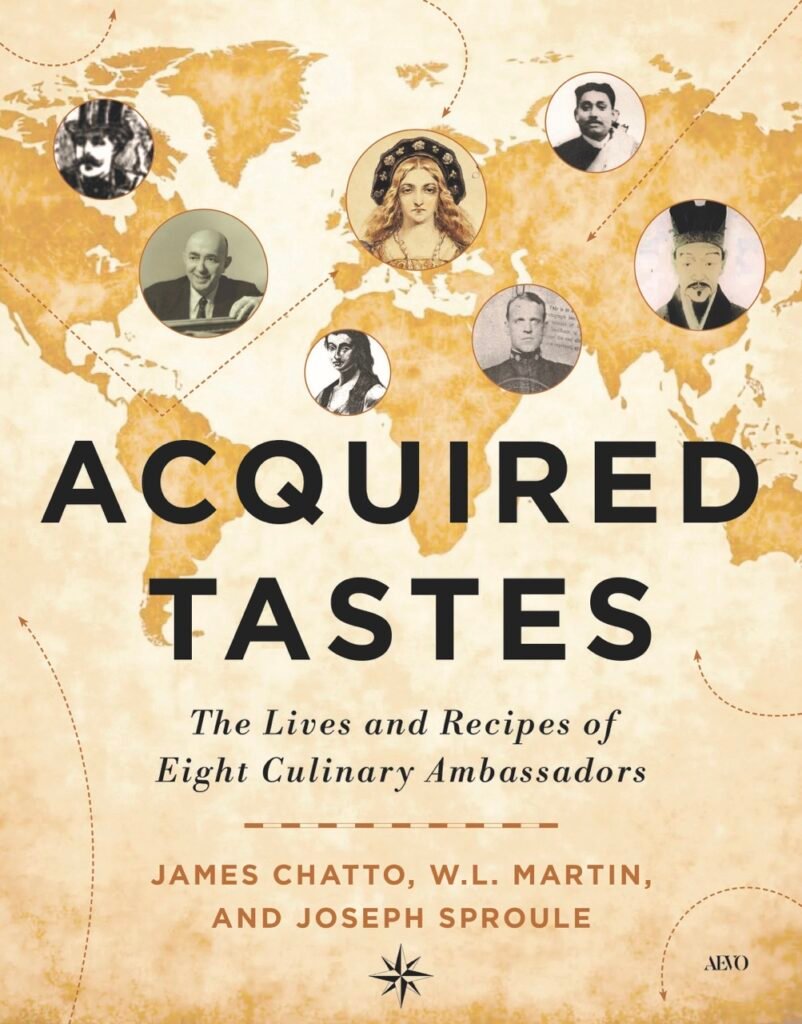
James Chatto & Co Releases “Acquired Tastes”
This is not specifically a wine book, or a book focused on Canada, but its author is a dear amigo and perhaps the most accomplished writer about food and wine that Canada has produced. We first shared pages in Toronto Life magazine, and co-hosted many a fine wine dining event for its readers. We worked together for over 15 years with Canada’s Great Kitchen Party and the Canadian Culinary Championships, which staged chef competitions across Canada, from which we both have recently retired. He continues to write about wine for Canadas 100 Best, LCBO Food and Drink and Elle Gourmet.
Acquired Tastes is a fascinating, unique, cultural and historical who-dunnit. The sub-title is “The Lives and Recipes of Eight Culinary Ambassadors” who lived at various points of history in various places around the globe. Put another way in the publisher’s media release “Acquired Tastes traces the global journeys and cultural influence of iconic dishes”.
As a sampler, the book chronicles Fujianese merchant Chen Zhenlong’s smuggling of the sweet potato from Manila to China, reshaping food security. Then there is Queen Bona Sforza’s introduction of Renaissance Italian lasagna into Poland, and U.S. Navy doctor Lucius W. Johnson’s role in popularizing the Cuban Daiquiri.
“Recipes don’t just move because they’re good,” says Chatto. “They move because people move — through love, exile, ambition, necessity, or sheer curiosity. What fascinated us was how these dishes became vessels for much larger human stories, and how food so often reveals history in ways that official records never can.”
One can only imagine the depth and allure of the research involved, but James and his co-authors were up to the task. Co-author W.L. Martin studied art history and Ancient Near Eastern history and has written several articles and books in development related to eighteenth-century French cuisine. Joseph Sproule is a historian of the early modern Baltic who completed his PhD at the University of Toronto and has completed academic research in nine countries. Wendy Martin is James Chatto’s wife, Joseph Sproule is their son.
Published by University of Toronto Press, the book is now on-sale at major bookstores across Canada, and in the U.S. and the U.K.
